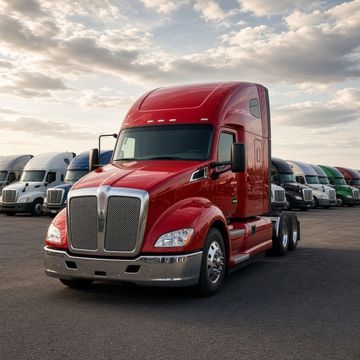
History of the 18-Wheeler: From Early Motor Trucks to Modern Semis

Get Big Rig Daily free every morning
The trucking stories drivers are talking about, in one short email. Free. Unsubscribe any time.
The 18-wheeler is so common on American highways that it is easy to forget it had to be invented, one piece at a time. The engine, the trailer, the roads, the sleeper and the rules all came together over more than a century. This guide follows that story using museum collections, government records and the builders' own histories.
The first motor trucks
Daimler Truck traces the first truck in the world to Gottlieb Daimler in 1896. A four horsepower, two-cylinder engine called the Phoenix sat at the rear and drove the rear axle by a belt, and the truck rolled on hard iron wheels. Its first buyer came from England.
Progress came fast. In 1898, according to the company, Daimler and Wilhelm Maybach first moved the engine under the driver's seat, then that same year to the very front, ahead of the front axle. Daimler Truck describes that step as the basis of today's truck.
Get Big Rig Daily free every morning
The trucking stories drivers are talking about, in one short email. Free. Unsubscribe any time.
In the United States, the Iowa State University Institute for Transportation credits carmaker Alexander Winton of Cleveland with an early semi-trailer truck. Winton needed to deliver new cars to buyers hundreds of miles away without putting miles on them, so he built a car hauler. By 1899 his company was making the hauler for its own use and for other carmakers.
The semi-trailer is born
The best-known origin story starts in a Detroit blacksmith shop. The Henry Ford museum says that in 1914, blacksmith August Fruehauf built a simple single axle trailer for lumber dealer Frederic Sibley. Hooked to a modified Ford Model T, it carried Sibley's boat on vacation trips. Sibley then had Fruehauf modify the trailer to haul lumber.
Fruehauf called it a "semi-trailer," and the museum calls it the ancestor of the trailers carrying freight on American roads today. The museum's records list the makers as August Charles Fruehauf and Otto Neumann. Because his middle name was Charles, some histories call him Charles Fruehauf, but he is the same August Fruehauf. The Institute for Transportation says the business grew quickly, and the Fruehauf Trailer Company was incorporated in 1918.
Roads catch up
Early trucks needed better roads. The National Park Service says Route 66 began in 1926 as part of the nation's first federal highway system, running about 2,400 miles from Chicago to Los Angeles, and was not completely paved until 12 years later. Its mostly flat route and milder weather appealed to truckers. Between Chicago and St. Louis, trucks on the road grew from about 1,500 a day in 1931 to 7,500 a day a decade later, and a quarter of them were tractor and semi-trailer rigs.
Weight rules grew too. The Federal Highway Administration (FHWA) says several states passed the first truck weight limits in 1913, and by 1933 every state had some size and weight law.
Diesel power and the first sleepers
The 1930s brought two changes drivers still feel today. Kenworth says that in 1933 it became the first American truck manufacturer to install diesel engines as standard equipment. The first went to Valley Motor Express in California with a 100 horsepower Cummins engine and what Kenworth calls the industry's first vertical exhausts.
Kenworth says diesel made longer routes, such as Seattle to Los Angeles, more economical, and longer routes meant drivers needed rest on the road. Also in 1933, Kenworth introduced an integrated sleeper with just enough room for a driver to lie down. The company says it did not develop a separate sleeper compartment until 1947.
Rules of the road
Federal regulation arrived in 1935. Kenworth's history says the Motor Carrier Act of 1935 led to Interstate Commerce Commission (ICC) rules with established routes and fixed rates. That system of route and rate rules lasted until the Motor Carrier Act of 1980.
The Interstate Highway System
The road network trucks run on today began on June 29, 1956, when President Dwight D. Eisenhower signed the Federal-Aid Highway Act of 1956. FHWA says Eisenhower had crossed the country with an Army convoy in 1919 and saw the poor condition of the roads. The 1956 Act set a limit of 41,000 miles for the new program, with the federal government paying 90 percent of the cost through the new Highway Trust Fund. FHWA lists the system today at 46,876 miles.
The same law brought the first federal truck size and weight limits. According to FHWA, combination trucks were limited to 73,280 pounds gross, 18,000 pounds on a single axle and 32,000 pounds on a tandem, with a width of 8 feet. In 1974, Congress let states raise Interstate limits to 80,000 pounds, but the increase was optional and some states kept lower limits. The how weigh stations work guide explains how today's limits are enforced.
Cabovers and conventionals
For decades, length rules shaped what trucks looked like. Kenworth says it built its first cab-over-engine (COE) truck, the Model 516, in 1936 because New Mexico allowed plenty of weight per axle but only a 45-foot length. The company says the design was efficient and met the legal limits, but it was not a hit with drivers, who preferred the traditional cab.
Both styles stayed in production. Kenworth introduced its K100 cabover line in 1963, the same year as its W900 conventional, and in 1976 it brought out the raised-roof Aerodyne sleeper with seven feet of headroom. The classic semi trucks guide covers the K100, the W900 and other famous models.
The 1982 change
The Surface Transportation Assistance Act of 1982 changed the length math. Federal records say it required states to allow semitrailers of at least 48 feet and widths of 102 inches on a national network of highways, and it required every state to allow 80,000 pounds on the Interstate System. FHWA also says that on that network, states may not set an overall length limit on a tractor and semitrailer when the trailer is 48 feet or less, or a grandfathered length. On those routes, a longer tractor no longer cut into the length allowed for the trailer.
Deregulation: the Motor Carrier Act of 1980
On July 1, 1980, President Jimmy Carter signed S. 2245, the Motor Carrier Act of 1980, Public Law 96-296. In his signing statement, he said it would remove regulations that had insulated trucking from competition since 1935. He said trucks would no longer travel empty because of rules limiting the goods they could carry, or be forced hundreds of miles out of their way. The law created a strong presumption in favor of new carriers entering the business and gave companies more freedom to set their own rates.
The Government Accountability Office (GAO) later reported that the Act increased competition in trucking, mostly from existing firms expanding, and that price competition had grown considerably. For drivers thinking about running their own truck today, the owner operator vs company driver guide compares the two paths.
Modern trucks
Fuel prices pushed trucks toward smoother shapes. Kenworth says it introduced the aerodynamic T600A on February 28, 1985, and that its own testing found the T600 20 percent more fuel efficient than its W900. Sleepers kept growing as well: Kenworth's Studio Sleeper of 1993 was 74 inches long, and the T680 introduced in 2012 came with a 76-inch integrated sleeper with a full-height roof.
Power sources are changing too. Kenworth launched its first Class 8 battery electric truck, the T680E, on October 14, 2020, and in 2021 began a 10-truck hydrogen fuel cell demonstration with partners including the Port of Los Angeles.
The truck weight and axle calculator checks axle loads in seconds, and more are on the Tools page.
Frequently Asked Questions
Who built the first truck?
Daimler Truck credits Gottlieb Daimler with building the world's first truck in 1896, a cart-like vehicle with a four horsepower Phoenix engine at the rear.
Who invented the semi-trailer?
The Henry Ford museum says Detroit blacksmith August Fruehauf built a semi-trailer in 1914 for lumber dealer Frederic Sibley, and lists Otto Neumann as a co-creator. Some histories call him Charles, his middle name. Alexander Winton built a car hauler by 1899.
When was the Interstate Highway System created?
President Eisenhower signed the Federal-Aid Highway Act of 1956 on June 29, 1956, launching the construction program for the Interstate System.
Why were cabover trucks built?
Length limits played a big part. Kenworth says it built its first cabover in 1936 to meet New Mexico's 45-foot length limit.
What did the Motor Carrier Act of 1980 do?
It loosened federal economic regulation of trucking that dated to 1935, making it easier for new carriers to enter the business and giving companies more freedom to set rates.
This guide draws on museum records, government histories and manufacturer accounts. Dates and firsts are as each source describes them.
Save this story for later

Sources
- Daimler Truck: The first truck in the world was built by Gottlieb Daimler in 1896 (Apr. 9, 2021)
- Iowa State University Institute for Transportation: Origins of the semi-trailer truck (Oct. 23, 2017)
- The Henry Ford: 1914 Fruehauf Truck Trailer
- National Park Service: Route 66, 1926 to 1945 (Travel Route 66 essay series)
- Kenworth: 100 Years, Through the Years
- Kenworth: For 90 Years, Kenworth Has Developed Innovations Focused on Customer Needs (July 8, 2013)
- FHWA: Interstate Frequently Asked Questions
- FHWA: Compilation of Existing State Truck Size and Weight Limit Laws, Report to Congress
- U.S. DOT Testimony: Truck Weights and Lengths, Assessing the Impacts of Existing Laws and Regulations
- FHWA: Non-regulatory Supplement for Part 658
- The American Presidency Project: Motor Carrier Act of 1980, Statement on Signing S. 2245 Into Law (July 1, 1980)
- U.S. GAO: Status and Impact of the Motor Carrier Act of 1980
- Public Law 96-296, Motor Carrier Act of 1980 (GovInfo)
Get Big Rig Daily free every morning
The trucking stories drivers are talking about, in one short email. Free. Unsubscribe any time.
More from Big Rig Daily