Truck Parking Tips and Apps: How Drivers Find a Safe Spot

Get Big Rig Daily free every morning
The trucking stories drivers are talking about, in one short email. Free. Unsubscribe any time.
Finding a safe, legal place to park a big rig is one of the most common challenges in trucking. Federal survey work shows nearly every driver has dealt with it, and the problem tends to peak at the same times every week. This guide covers the federal data, practical planning tips, and what common parking apps and truck stop programs say they offer on their own websites or app store pages.
Why truck parking takes planning
The Federal Highway Administration (FHWA) runs a truck parking survey under Jason's Law, Section 1401(c) of the MAP-21 transportation law. In a December 2020 presentation to the National Coalition on Truck Parking, FHWA shared results from its 2019 survey:
- There were about 313,000 truck parking spaces nationally, about 40,000 at public rest areas and about 273,000 at private truck stops.
- Public spaces rose about 6 percent and private spaces about 11 percent from 2014 to 2019.
- 98 percent of drivers reported problems finding safe parking, and 75 percent said they had problems regularly, once a week or more.
The same presentation said the average truck stop in the survey had 143 spaces, that 78 percent of truck stops did not offer reservations and that 75 percent did not charge for parking.
Get Big Rig Daily free every morning
The trucking stories drivers are talking about, in one short email. Free. Unsubscribe any time.
When parking is hardest
FHWA reported that drivers found parking hardest to find from 4 PM to 5 AM, Monday through Thursday, and from October through February. The states drivers mentioned most were New York, New Jersey, Pennsylvania, Illinois and Georgia, and the corridors mentioned most were I-95, I-5 in California and the Chicago region.
Tips for finding a spot
Plan the stop before the clock runs low
Federal hours of service rules in 49 CFR 395.3 allow up to 11 hours of driving within a 14-hour window that starts after 10 consecutive hours off duty. Once the window closes, a driver generally cannot keep driving to find a better spot (personal conveyance, covered below, is a narrow exception), so the parking decision has to be made with time to spare. This is general information, not legal advice. For a plain-English walk-through of these limits, see the guide to hours of service and ELD rules.
Some fleet tools now help with this. As covered in a look at new AI fleet alert tools, one fleet software company described an hours of service alert set to warn drivers 60 minutes before a limit, a buffer that can leave time to find safe parking. The free hours of service break calculator can also help a driver see how much time is left before planning the night's stop.
Keep a backup and a second backup
Since evenings and weeknights are the busiest times, it helps to pick a first choice and at least two fallback stops along the route before the day starts.
Know which spots can be reserved
Most truck stop parking is first come, first served, but some chains sell reserved spaces. The app section below explains how the major programs describe their reservations.
Use public rest areas and state parking signs
Several states run Truck Parking Information Management Systems, often called TPIMS. According to FHWA, these systems use sensors or cameras to count open spaces and then share the counts through roadside message signs, state 511 traveler information sites, mobile apps and in-cab systems. FHWA describes a regional project led by the Kansas Department of Transportation covering Indiana, Iowa, Kansas, Kentucky, Michigan, Minnesota, Ohio and Wisconsin. Watching for these signs and checking a state's 511 site can show open spaces at rest areas ahead.
Understand personal conveyance
FMCSA guidance on personal conveyance lists time spent traveling to a nearby, reasonable, safe location to get required rest after loading or unloading as one appropriate off-duty use of a truck. The guidance says the resting location must be the first one reasonably available, and that motor carriers can set stricter limits or ban personal conveyance. This is general information, not legal advice, so drivers should check their carrier's policy and the FMCSA guidance itself.
Follow posted rules
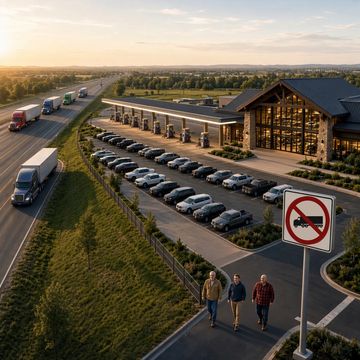
FHWA lists improper parking on highway shoulders and ramps as a key safety concern tied to the parking shortage. Drivers should obey posted signs, since some businesses do not allow trucks at all. One example is the travel center chain whose new stores are opening in 2027, where signs reported at one Texas store kept semi trucks off the lot. Local parking rules vary, so check the rules for each city and state.
Truck parking apps and what they say they do
The descriptions below come from each company's own website or app store page. Features change often, so check the current version of each app.
Trucker Path
Trucker Path says its app helps drivers find truck stops and their amenities, and shows real-time available parking at truck stops and rest areas. It also lists weigh station status updated by drivers, fuel prices, truck navigation, saved favorite places, a job search and more than 400 truck wash locations.
Pilot app and Prime Parking
Pilot Company sells reserved truck spaces under the name Prime Parking. Its FAQ says drivers can reserve through the Parking icon or Find tab in the Pilot app, on the website, or at the register. The website takes bookings up to 30 days ahead, while the app handles same-day and next-day reservations. The FAQ lists refunds for cancellations made before noon local store time on the day of the reservation, and says dropped trailers are not allowed in reserved spaces. Refund terms can change, so check the current policy when booking. In August 2026, Pilot said Prime Parking was moving from paper hang tags to digital check-in through the app, using the truck's license plate to help verify the reservation.
earnify pro for TA and Petro
TravelCenters of America says its earnify pro app is replacing the TruckSmart and UltraONE programs and offers fast booking of showers and parking. TA's Reserve-It program lets drivers book a space in advance.
Love's app
The Love's app store listing says the app finds Love's locations by city, state, zip code or highway, lets drivers search by amenities, and offers shower check-in, mobile fuel pay and real-time fuel prices. Love's says truck parking is free for its customers, as covered in the guide to the big truck stop chains.
State 511 and parking systems
In TPIMS states, FHWA says parking counts go to 511 websites and message signs, and some states share the data with outside app makers.
Paid and gated parking
Some truck stops charge for parking. TA's gated parking page says that at participating locations the first 2 hours are free, buying 60 or more gallons of diesel or reefer fuel earns up to 24 hours of free parking, and other qualifying purchases also validate the ticket. A Reserve-It reservation waives the gate fee during the reserved period. The page lists a $25 parking fee at its standard gated locations.
Frequently Asked Questions
How hard is it to find truck parking?
In FHWA's 2019 survey, 98 percent of drivers reported problems finding safe parking, and 75 percent said it happened once a week or more.
When is truck parking hardest to find?
FHWA reported the hardest times were 4 PM to 5 AM, Monday through Thursday, and October through February.
Can truck parking be reserved?
Yes, at some stops. Pilot sells Prime Parking reservations through its app, website and registers, and TA offers Reserve-It spaces. In FHWA's survey, 78 percent of truck stops did not offer reservations.
Is truck parking free?
Often, but not always. FHWA's survey found that 75 percent of truck stops did not charge. Love's says parking is free for its customers, while TA charges a fee at some gated locations unless the driver qualifies for free parking.
Which apps show truck parking availability?
Trucker Path says it shows real-time available parking at truck stops and rest areas. Chain apps from Pilot and TA handle reservations at their own locations, and state 511 sites show counts at rest areas in states with parking systems.
Rules and app features change, and this guide is general information, not legal advice. Check posted signs, carrier policy and current FMCSA guidance before relying on any parking option.
Share your thoughts on our Facebook page.
Save this story for later

Sources
- FHWA: National Coalition on Truck Parking presentation, Jason's Law 2019 survey (Dec. 1, 2020)
- FHWA: Truck Parking Availability Detection and Information Dissemination
- eCFR: 49 CFR 395.3 Maximum driving time for property-carrying vehicles
- FMCSA: Personal Conveyance
- Pilot Company: FAQs, Prime Parking (viewed Oct. 2026)
- Pilot newsroom: Welcome to Pilot's New Prime Parking Experience (Aug. 2026)
- TravelCenters of America: Automated Gated Parking (viewed Oct. 2026)
- TravelCenters of America: earnify pro (viewed Oct. 2026)
- Trucker Path: Trucker Path app (viewed Oct. 2026)
- Apple App Store: Love's app listing (viewed Oct. 2026)
Get Big Rig Daily free every morning
The trucking stories drivers are talking about, in one short email. Free. Unsubscribe any time.
More from Big Rig Daily
- Trucker Asks FMCSA to Stop Random Drug Test Notices on Drivers' Days Off
- Ohio Milk Hauler Bill Wilker, Known on the CB as Milkman, Remembered After 3 Million-Plus Safe Miles
- Michigan Resident Dresses as Satan to Protest Bay City Bridge Toll Hike That Could Charge Some Truckers $13.50
- Tesla Says Its Electric Semi Is Now in Volume Production, With Capacity for 25,000 Trucks a Year

