Wyoming's 50-Year-Old Runaway Truck Ramps Still Do Their Job

Get Big Rig Daily free every morning
The trucking stories drivers are talking about, in one short email. Free. Unsubscribe any time.
Anyone who has come down a long mountain grade has seen them: a lane of deep gravel peeling off the highway, waiting for a truck that has run out of brakes. In Wyoming, some of those ramps are more than 50 years old, and a state highway engineer says they still work.
Cowboy State Daily took a close look at how they work in a report published Oct. 24.
"The trucker nightmare"
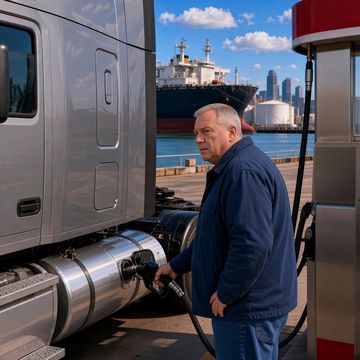
Mike Talton, a trucker with 10 years behind the wheel, hauls liquid oxygen from Salt Lake City to uranium mines in the Powder River Basin, according to Cowboy State Daily. The outlet caught up with him while he was fueling at the Love's Travel Stop in Cheyenne.
Get Big Rig Daily free every morning
The trucking stories drivers are talking about, in one short email. Free. Unsubscribe any time.
"Yeah, that's a bad deal. Having to use one of those is kind of the trucker nightmare situation driving in the mountains," Talton said.
"I've never had to use one, but I always keep an eye open," he said. "All my driving has been in the Rockies, so you know where they are, for sure."
Talton called the ramps "the difference between getting stopped in that sand and a bunch of people getting hurt or killed."
How a gravel bed stops a truck
Bob Hammond, a resident engineer for the Wyoming Department of Transportation in Jackson, explained how a gravel arrester bed works.
"The whole purpose is to use rounded, pebble-sized gravel that tires will sink into," Hammond told Cowboy State Daily. "As the tires and the bottom of the vehicle rub and push a bunch of rock, the friction stops the vehicle."
According to Hammond, most arresters are 700 to 1,800 feet long and filled with 3 to 4 feet of rounded gravel. Building uphill lets gravity help.
"For an uphill arrester, you could probably put in something that's only 700 feet long to have the truck stopped," he said. "For a truck of the same weight and speed, a downhill arrester could be as long as 1,800 feet."
Cowboy State Daily also cited a 2023 study in the journal Transportation Research Procedia that found gravel arresters can stop a vehicle in as little as 150 feet, depending on its weight and whether the driver is braking.
Most beds are built so the ramp can "peel away" from the highway, Hammond said, because a truck sinking into the gravel sprays rock ahead and behind.
Old ramps, still working
Hammond said WYDOT has several gravel arrester beds along Wyoming's mountain passes, and despite being more than 50 years old, they remain effective and easy to maintain. The outlet listed ramps on U.S. Highway 14A between Lovell and Burgess Junction and on U.S. 14 east of Shell Falls.
The newer option: catch nets
Hammond said catch-net systems use eight to 10 spools of metal ribbon that absorb a runaway vehicle's energy as the ribbon pulls out.
"A 500-foot catch-net system can accomplish what would take an 1,800-foot downhill gravel arrester," he said.
He oversaw construction of a downhill catch-net system on Teton Pass in 2017, and it has been used at least 10 times since, according to the report. Every time a net is used, the nets and spools must be replaced. WYDOT keeps two full systems in reserve so a new one can go in within a few hours.
According to Cowboy State Daily, the recent arresters WYDOT has built have been catch-net systems, because they need much less space.
A ramp that worked
The report also pointed to a Colorado State Patrol dash camera video from last month showing a semi on westbound I-70 near the Eisenhower Tunnel that steered into a runaway ramp and stopped safely in the gravel.
For more on mountain driving and equipment checks, see the Big Rig Daily pre-trip inspection checklist, which includes a brake check, and the truck laws by state guide to chain and traction rules.
A question for readers
Talton says he has never needed one, but he always knows where they are.
Have you ever had to take a runaway ramp, or watched someone else take one?
Save this story for later

Sources
Get Big Rig Daily free every morning
The trucking stories drivers are talking about, in one short email. Free. Unsubscribe any time.
More from Big Rig Daily