English Proficiency Rule for Truck Drivers: What Inspectors Check

Under 49 CFR 391.11(b)(2), truck drivers must read and speak English well enough to talk with the public, understand highway signs, answer official questions and fill out reports. At roadside, the inspector interviews the trucker in English, then checks road signs. Failing means a citation and an out-of-service order, unless the whole trip stays in a U.S.-Mexico border commercial zone.
Rule status as of Oct 26, 2026: failing the English language proficiency (ELP) check has been a driver out-of-service violation under the Commercial Vehicle Safety Alliance (CVSA) out-of-service criteria since June 25, 2025, and under FMCSA policy MC-SEE-2026-0002. FMCSA's proposal to write this into the federal regulations (Docket FMCSA-2026-0826) closed for comments Oct 9, 2026. A final rule has not been published yet.
Get Big Rig Daily every morning
The trucking stories drivers are talking about, in one short email. Unsubscribe any time.
After you sign up, check your inbox for an email from news@bigrigdaily.com and tap the button to confirm.
This guide walks through the rule, the two step roadside check, the border zone exception and the pending rule. It is general information, not legal advice.
What the English proficiency rule says for truck drivers
Under 49 CFR 391.11(b)(2), a person is qualified to drive a commercial motor vehicle (CMV) if he or she:
- "Can read and speak the English language sufficiently to converse with the general public, to understand highway traffic signs and signals in the English language, to respond to official inquiries, and to make entries on reports and records"
Because it sits in part 391 with the other driver qualifications, such as age, a valid license and the medical card, a trucker who cannot meet it is not qualified to drive a CMV in interstate commerce. Section 391.11(a) also says a motor carrier "shall not require or permit a person to drive" a CMV unless that person is qualified.
Get Big Rig Daily every morning
The trucking stories drivers are talking about, in one short email. Unsubscribe any time.
After you sign up, check your inbox for an email from news@bigrigdaily.com and tap the button to confirm.
Who it covers and who it does not
- Interstate truck drivers in the U.S.: FMCSA's roadside policy applies to drivers operating a CMV in interstate commerce in the United States.
- Any license country: per FMCSA's FAQ, it applies whether the driver holds a U.S. CDL, a Mexican Licencia Federal de Conductor or a Canadian CDL.
- Truckers excepted from part 391: the policy does not apply to drivers excepted from part 391, such as certain farm, apiary and custom harvesting operations under 49 CFR 391.2, or those operating under the exemptions in 49 CFR 390.3T(f) (FMCSA FAQ, Question 5, Oct 6, 2026).
- Hearing-impaired truckers: drivers who hold an FMCSA exemption from the hearing standard and can read and write English are not placed out of service for being unable to speak English. That comes from 2014 FMCSA guidance (79 FR 59139), which the current policy keeps in effect.
- U.S. territories: the federal policy does not apply to inspections in Puerto Rico, Guam, the Northern Mariana Islands or American Samoa.
- Intrastate-only truckers: the federal policy covers interstate operations, and state rules vary. See truck laws by state for other state rules.
- State laws: according to an Oct 21, 2026 news report, Indiana's HEA 1200, authored by State Rep. Jim Pressel, required truck drivers in Indiana to demonstrate English language proficiency, a state law separate from the federal roadside check.
For the medical side of part 391, see DOT physical and medical card basics.
What roadside inspectors check: the two step ELP assessment
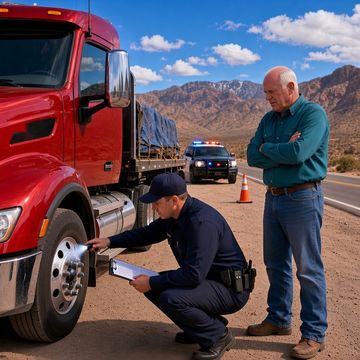
FMCSA's policy tells inspectors to start every roadside inspection in English. If the first contact suggests the trucker may not understand the inspector's instructions, the inspector runs an ELP assessment. It has two steps, and the second step only happens if the trucker passes the first. Many inspections happen at the scale house; see how weigh stations work.
Step 1: the English interview
- Answers must be in English: the inspector checks whether the trucker can respond to official inquiries and directions in English.
- No translation tools during the interview: the policy says interpreters, I-Speak cards, cue cards, smartphone apps and phone interpretation services should not be used during this step, because they "may mask" a driver's inability to communicate in English.
- How the inspector explains it: the inspector may explain the process in English or any language the trucker understands, and should speak slowly but naturally, not rush the questions, and paraphrase in English as needed.
- If the trucker cannot respond well enough: the inspector cites a violation of 391.11(b)(2) and does not go on to Step 2.
FMCSA's public copy of the policy withholds the list of interview questions. No official sample questions have been released, so this guide does not list any.
Step 2: the highway sign check
- Which signs: highway traffic signs that follow the Federal Highway Administration's Manual on Uniform Traffic Control Devices (MUTCD), plus electronic changeable message signs, sometimes called dynamic message signs.
- Focus on reading English: the April 2026 policy removed signs with little or no lettering from its examples, so the check is about reading and understanding English on signs.
- No public sign test: the sign examples in the policy are also withheld from the public copy, and this guide does not make up a sign quiz.
A trucker who passes both steps may finish the inspection using whatever communication methods work best.
What changed from the older approach
Under a 2008 FMCSA policy, a driver could explain the meaning of a sign in another language if the inspector understood the explanation. Today's policy checks whether the trucker can understand signs in the English language, and the interview must be answered in English.
When a truck driver gets put out of service for ELP
Failing either step leads to a citation under 391.11(b)(2). Under the policy, the inspector should then place the driver out of service immediately, unless the border commercial zone exception applies.
- Evidence is recorded: the inspector must document the evidence for the violation, including the driver's answers or lack of answers.
- What the trucker is told: the inspector should advise that it is unlawful to operate a CMV while out of service, and that the driver should not operate CMVs in interstate commerce "until the condition is remedied."
- Possible disqualification: FMCSA may also start a driver qualification proceeding by issuing a letter of disqualification under 49 CFR 386.11(a). FMCSA's FAQ notes this process may not apply to other enforcement agencies.
FMCSA's public policy does not spell out how or when an ELP out-of-service order is lifted, so this guide does not guess. For a specific citation, contact your carrier's safety department or FMCSA's information line at 1-800-832-5660.
A driver out-of-service order for ELP is different from a vehicle out-of-service order for a defect, which is covered in the pre-trip inspection checklist.
The violation codes on your inspection report
FMCSA's FAQ lists three violation codes for 391.11(b)(2) in FMCSA's SafeSpect system, in place since June 25, 2025:
- 391.11B2Z: the border commercial zone code, marked as a non-out-of-service violation
- 391.11B2Q and 391.11B2S: marked as out-of-service violations
Inspectors cannot change the out-of-service setting on these codes. FMCSA's FAQ does not say what the letters Q and S stand for.
What it means for carriers
Under 391.11(a), a motor carrier must not require or permit an unqualified person to drive a CMV. In its proposed rule, FMCSA says carriers are responsible for making sure a driver is qualified before the next dispatch, and that it does not require carriers to train drivers in English.
The U.S.-Mexico border commercial zone exception
The exception depends on the driver's current trip, not on where the stop happens or the driver's nationality.
- Trip stays inside the border commercial zones: the driver is cited but not placed out of service.
- Trip went or will go outside the zones: the driver is cited and placed out of service.
- What the inspector looks at: bills of lading, dispatch records, equipment interchange receipts, driver statements and other shipping papers.
FMCSA's policy gives these examples:
- Out of service: a load picked up at a Laredo, Texas, warehouse for delivery to Detroit
- Out of service: a load picked up in Detroit for delivery to a Laredo warehouse
- Out of service: a driver entering from Nuevo Laredo, Mexico, with a load for San Antonio
- Out of service: a load from San Antonio to a delivery point in Mexico
- Cited, not out of service: a shipment from Nuevo Laredo to a local trans-load facility or warehouse inside the Laredo commercial zone, even if the cargo later goes farther with a different driver
Border commercial zones are set in 49 CFR part 372, subpart B. Per FMCSA's FAQ, a border city's zone generally ranges from 3 to 20 miles depending on the city's population, and Cameron, Hidalgo, Starr and Willacy Counties in Texas, the City of El Paso and the New Mexico commercial zones also count. For a look at a border area inspection site, see Transmountain Road truck inspections in El Paso.
The April 16, 2026 policy, followed by a CVSA criteria update on April 19, 2026, narrowed the earlier border zone exception so it now covers only trips that stay inside the zones.
How the ELP rule got here: a short timeline
- April 1, 2005: CVSA adds 391.11(b)(2) to its out-of-service criteria.
- April 1, 2015: CVSA removes it.
- June 15, 2016: FMCSA memo MC-ECE-2016-006 tells personnel to cite ELP violations but not place drivers out of service.
- April 28, 2025: Executive Order 14286 directs FMCSA to issue new ELP enforcement guidance and work toward restoring out-of-service enforcement.
- May 20, 2025: FMCSA issues policy memo MC-SEE-2025-0001.
- June 25, 2025: ELP failure becomes a driver out-of-service violation in CVSA's criteria.
- Oct 25, 2025: CVSA petitions FMCSA to put ELP out-of-service enforcement into the regulations.
- April 16, 2026: FMCSA memo MC-SEE-2026-0002 replaces the 2025 memo.
- April 19, 2026: CVSA updates its criteria to follow "current FMCSA enforcement guidance."
- Aug 10, 2026: FMCSA publishes the proposed rule, 91 FR 51422, Docket FMCSA-2026-0826.
- Oct 6, 2026: FMCSA revises its ELP FAQ and adds Question 5 on drivers excepted from part 391.
- Oct 9, 2026: the comment period closes.
What FMCSA's proposed rule would change
Roadside practice already places truckers out of service for ELP failures. The proposal would write that into the federal regulations, so it would not depend only on CVSA's criteria and an internal FMCSA memo. FMCSA proposed three changes:
- Out-of-service order definition: add 391.11(b)(2) to the definition of "out-of-service order" in 49 CFR 390.5T, and in the suspended 390.5.
- New 391.11(c)(1): a driver found in violation of (b)(2) while operating a CMV in interstate commerce "shall be placed out-of-service immediately."
- New 391.11(c)(2): the border commercial zone exception, unless there is evidence the person has operated or intends to operate a CMV beyond the zones.
FMCSA estimates the proposal would cost motor carriers about $14.4 million a year. That figure rests on FMCSA's assumption of about 9,000 drivers placed out of service each year in the border zones, at $800 a day for two days each. It is an agency estimate, not a measured outcome.
FMCSA's own data in the proposal shows how enforcement changed: from June 25, 2025 through March 19, 2026, inspectors issued 60,399 ELP violations, and 19,045 of them led to out-of-service orders.
What commenters said
The docket received 2,203 public comments, according to the Federal Register's docket data as of Oct 14, 2026. According to a trade press summary of the comments:
- Support: the American Trucking Associations (ATA), the Owner-Operator Independent Drivers Association (OOIDA), the Truckload Carriers Association and the Commercial Vehicle Training Association backed the proposal.
- Caution: the Ascendant Trucking Industry Association, which represents immigrant-owned carriers and drivers, warned about subjective roadside checks and asked for a 12-month transition and standard criteria.
- Standard test: ATA also asked for a standardized national assessment.
- Clear guidance: the Transportation Intermediaries Association, which represents freight brokers, asked for clear, nationally consistent guidance before a final rule takes effect.
Is there a final rule yet?
Not as of Oct 26, 2026. The Federal Register shows only the Aug 10, 2026 proposed rule for Docket FMCSA-2026-0826.
How truck drivers can prepare
Practical steps, not official test content:
- Practice in English: get comfortable talking through your trip, your load and your paperwork in English.
- Review road signs: study MUTCD warning and regulatory signs and the wording on electronic message signs. The CDL general knowledge test study guide and the CDL practice test cover signs and rules of the road.
- Keep trip papers handy: bills of lading and dispatch records are what an inspector uses to decide the border zone question.
- Be ready for any inspection: use the pre-trip inspection checklist, keep your logs in order with the ELD and hours of service rules explained, and plan stops with the hours of service break calculator.
- New to trucking: see how to get a CDL step by step.
More planning tools are on the Trucking Tools page, including the truck stop and weigh station map.
This page is general information, not legal advice. Rules and enforcement policy can change.
FAQ
What is the English proficiency rule for truck drivers?
It is 49 CFR 391.11(b)(2). Truck drivers in interstate commerce must read and speak English well enough to converse with the general public, understand highway traffic signs and signals in English, respond to official inquiries, and make entries on reports and records. A trucker who cannot meet it is not qualified to drive a CMV.
What do inspectors ask truckers in an ELP check?
First comes an interview in English with no interpreter, cue cards or phone apps. A trucker who passes then gets a highway sign check using MUTCD and electronic message signs. FMCSA withholds the actual question list and sign examples from its public policy, so no official sample test has been released.
Can a trucker be put out of service for failing the English check?
Yes. Since June 25, 2025, failing the ELP check has been a driver out-of-service violation under CVSA's criteria and FMCSA policy. The trucker is cited and placed out of service immediately, unless the whole current trip stays inside a U.S.-Mexico border commercial zone, in which case the trucker is cited only.
What is the border commercial zone exception for truck drivers?
It depends on the current trip. A driver whose trip stays entirely inside the U.S.-Mexico border commercial zones is cited but not placed out of service. If the trip went or will go outside the zones, the driver is placed out of service. The zones are set in 49 CFR part 372, subpart B.
Can truckers use a translator or phone app during the check?
Not during the interview step. FMCSA's policy says interpreters, I-Speak cards, cue cards, smartphone apps and phone interpretation services should not be used then. If the trucker passes both steps, the inspector may finish the rest of the inspection using whatever communication methods work best for a safe, complete inspection.
Is the ELP rule for truck drivers final?
Not yet. FMCSA published the proposed rule on Aug 10, 2026, and comments closed Oct 9, 2026. As of Oct 26, 2026, no final rule had been published. Roadside out-of-service enforcement is already in place through CVSA's criteria and FMCSA policy, so the proposal mainly writes current practice into the regulations.
Does the ELP rule apply to farm or custom harvest truckers?
FMCSA's roadside ELP policy does not apply to drivers who are excepted from part 391. Per FMCSA's Oct 6, 2026 FAQ, that includes certain agricultural, apiary and custom harvesting operations under 49 CFR 391.2, and drivers operating under the exemptions in 49 CFR 390.3T(f). Truckers who are unsure should check their exact operation.
Do hearing-impaired truckers have to speak English?
Not if they hold an FMCSA exemption from the hearing standard and can read and write English. Under 2014 FMCSA guidance, which the current policy keeps in effect, those drivers are not considered unqualified or placed out of service under 391.11(b)(2) because they cannot communicate orally in English.
Save this story for later

Sources
- 49 CFR 391.11 General qualifications of drivers (eCFR)
- FMCSA: English Language Proficiency; Out of Service Criteria, proposed rule, 91 FR 51422 (Federal Register, Aug 10, 2026)
- Proposed rule, official GPO text (govinfo)
- Docket FMCSA-2026-0826 (Regulations.gov)
- FMCSA: ELP Guidance Roadside Policy, MC-SEE-2026-0002 (Apr 16, 2026)
- FMCSA policy memo MC-SEE-2026-0002, redacted public copy (PDF, hosted by CVSA)
- FMCSA: English Language Proficiency Roadside Enforcement Policy FAQs (revised Oct 6, 2026)
- CVSA: Non-Compliance with English Language Proficiency Regulation Takes Effect as an Out-of-Service Driver Violation (Jun 25, 2025)
- CCJ: FMCSA's proposed trucker language rule draws praise and pushback (Oct 12, 2026, updated Oct 15)
- CDLLife: Chameleon carrier crackdown promised in Indiana if Secretary of State candidate wins (Oct 21, 2026)
Get Big Rig Daily every morning
The trucking stories drivers are talking about, in one short email. Unsubscribe any time.
After you sign up, check your inbox for an email from news@bigrigdaily.com and tap the button to confirm.
Related stories