WattEV Opens a Public Electric Truck Charging Depot at the Port of Oakland and Rolls Out Its First Tesla Semis There

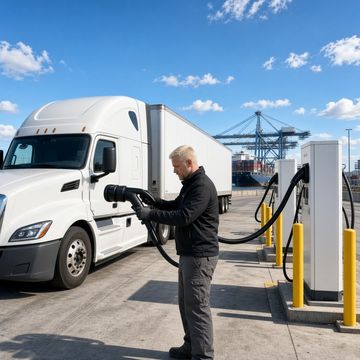
WattEV opened a public charging depot for heavy-duty electric trucks at the Port of Oakland on Monday, Nov. 23, and rolled out the first Tesla Semis it plans to run between the port and freight destinations in Northern California, according to the company's news release.
Get Big Rig Daily every morning
The trucking stories drivers are talking about, in one short email. Unsubscribe any time.
After you sign up, check your inbox for an email from news@bigrigdaily.com and tap the button to confirm.
Quick answer
WattEV, a company that builds and runs charging sites for electric big rigs, held a grand opening at 8407 Edgewater Drive in Oakland on Nov. 23. The release says the site can charge 25 medium- and heavy-duty electric trucks at once at up to 240 kW each, or seven trucks at 1.2 megawatts, with charging stops of 30 minutes or less. It is WattEV's eighth heavy-duty depot in California, and the company calls it Northern California's first public depot of its kind. WattEV said more than 300 electric Semis will eventually run a corridor from the Bay Area to Sacramento, the Central Valley and Nevada. Public money is part of the project: the Bay Area Air District gave it a $5 million grant in 2024 and helped WattEV secure a $4.1 million loan.
Key facts
- What: public charging depot for medium- and heavy-duty electric trucks
- Where: 8407 Edgewater Drive, Oakland, California, near the Port of Oakland
- Opened: Monday, Nov. 23, 2026
- Capacity (WattEV release): 25 trucks at up to 240 kW each, or seven trucks at 1.2 MW
- Capacity (Air District, April 2026): 36 chargers providing 7.2 megawatts in total
- Power: PG&E, through its Flex Connect program
- Public funding: $5 million Air District grant (2024), plus Air District help securing a $4.1 million loan
- Other WattEV depots: Port of Long Beach, Bakersfield, San Bernardino, Gardena, Vernon, Oxnard and Fresno
Who paid for it
The Air District said in its April 21 release that its Community Air Protection program awarded WattEV $5 million in 2024 for the Oakland site. Its Climate Tech Finance team, working with the California Infrastructure and Economic Development Bank, found WattEV eligible for a loan guarantee through PCR Business Finance, which helped the company get a line of credit with Stearns Bank. The district said the project is expected to cut 140,558 metric tons of carbon dioxide equivalent per year, about the same as 32,786 gasoline cars driven for a year.
Get Big Rig Daily every morning
The trucking stories drivers are talking about, in one short email. Unsubscribe any time.
After you sign up, check your inbox for an email from news@bigrigdaily.com and tap the button to confirm.
State money has also been lined up for WattEV in Oakland. Backup materials for the California Energy Commission's Aug. 14, 2024 business meeting show a proposed resolution approving agreement ZVI-23-031, a $13,203,368 grant to WattEV for 70 chargers rated at 240 kW and 14 megawatt chargers rated at 1,200 kW at public sites in Fresno, Stockton and Oakland, with the Oakland site less than a mile from I-580 and I-80. The packet does not split the money or the chargers by site, and Big Rig Daily did not find a record of how much of that grant has gone to the Oakland depot.
What the records do not settle
The two public descriptions of the Oakland site use different numbers. The Air District counted 36 chargers totaling 7.2 megawatts, while WattEV's opening release describes how many trucks can charge at once and at what power. The Air District also said in April that the site was expected to be open to fleets by March 25, 2027, so Monday's opening came about four months earlier than that date.
WattEV's release says the per-mile energy cost of the new trucks is lower than that of comparable diesel trucks at current diesel prices, but it gives no per-mile numbers and does not say how many Semis rolled out on Monday. An energy cost comparison is also not the full cost of buying and running a truck. Diesel has been expensive this fall, as Big Rig Daily reported today on a Minnesota flatbed company adding a fuel surcharge for the first time in its history.
What the partners said
"Until now, most truck charging infrastructure has been concentrated in Southern California," WattEV CEO and co-founder Salim Youssefzadeh said in the release. Port of Oakland Executive Director Kristi McKenney said the port is "delivering projects throughout Oakland that support cleaner freight operations, healthier communities, and a more sustainable future."
Air District Executive Officer Philip Fine said in April that the investment means "cleaner air for communities near the Port of Oakland that have been disproportionately impacted by diesel pollution."
Analysis
For people who live near the port, the payoff the agencies are paying for is fewer diesel trucks idling and running through West and East Oakland. For shippers and fleets, the open questions are how many electric trucks actually use the site, what charging costs per mile, and whether more than 300 Semis show up on the schedule WattEV describes. Those numbers are not in any public record yet.
Should public money keep going into truck charging near ports, or should it go somewhere else in freight?
Save this story for later

Sources
- WattEV, Inc. news release (GlobeNewswire, Nov. 23, 2026): WattEV's Port of Oakland charging depot and new electric trucks bring cost parity with diesel to fleets
- Bay Area Air District news release (April 21, 2026): Air District advances zero-emission trucking in East Oakland
- California Energy Commission, Aug. 14, 2024 business meeting backup materials for WattEV, Inc. (agreement ZVI-23-031)
- TeslaNorth (tip): Tesla Semis Debut at WattEV's New Port of Oakland Charging Depot
Get Big Rig Daily every morning
The trucking stories drivers are talking about, in one short email. Unsubscribe any time.
After you sign up, check your inbox for an email from news@bigrigdaily.com and tap the button to confirm.
Related stories