Memphis Trucker Loses Central Vision to a Rare Inherited Eye Disease and Has to Leave His Job Behind the Wheel

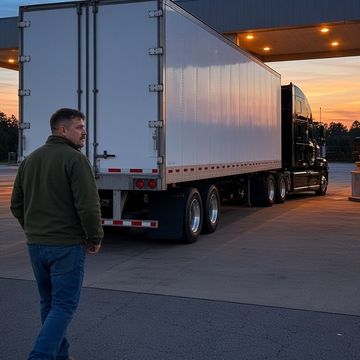
A Memphis trucker and father of five has had to give up his job behind the wheel after a rare inherited eye disease took most of his central vision, and the federal medical standard for commercial driving explains why a diagnosis like his can end a career overnight.
Get Big Rig Daily every morning
The trucking stories drivers are talking about, in one short email. Unsubscribe any time.
After you sign up, check your inbox for an email from news@bigrigdaily.com and tap the button to confirm.
Quick answer
Kajavias "KJ" Sanford, 36, told WREG in Memphis that about three months ago he woke up with blurry vision. He was later diagnosed with Leber hereditary optic neuropathy, or LHON. He still has his side vision, but he said reading, identifying faces and driving are now out, and he had to leave his trucking job. Under 49 CFR 391.41, a person needs distant vision of at least 20/40 in each eye, a field of vision of at least 70 degrees in each eye and the ability to recognize traffic signal colors to be physically qualified to drive a commercial motor vehicle.
Key facts
- Who: Kajavias "KJ" Sanford, 36, of Memphis, a father of five children ages 4 to 17
- What happened: about three months ago he woke with blurry vision that did not clear
- Diagnosis: Leber hereditary optic neuropathy (LHON), according to Sanford
- Effect: central vision lost, side vision kept, so he can no longer drive
- Federal standard: 20/40 distant acuity in each eye and a 70 degree horizontal field in each eye (49 CFR 391.41(b)(10))
- Next steps: Sanford said he has applied for disability, and a neighbor and friend set up an online fundraiser for medical bills and his children
What LHON is
MedlinePlus Genetics, published by the National Library of Medicine, describes LHON as an inherited form of vision loss. It usually begins in a person's teens or twenties, though some cases appear later in adulthood, and males are affected much more often than females. Blurring and clouding of vision are usually the first symptoms. The condition mainly affects central vision, which the agency says is needed for detailed tasks such as reading, driving and recognizing faces. Vision loss comes from the death of cells in the optic nerve. MedlinePlus says central vision gradually improves in a small percentage of cases, but in most cases the loss is profound and permanent.
Get Big Rig Daily every morning
The trucking stories drivers are talking about, in one short email. Unsubscribe any time.
After you sign up, check your inbox for an email from news@bigrigdaily.com and tap the button to confirm.
What the federal rule says
The federal physical qualification rule, 49 CFR 391.41, lists vision as one of 13 standards. Paragraph (b)(10) requires distant visual acuity of at least 20/40 in each eye, with or without corrective lenses, distant binocular acuity of at least 20/40, a field of vision of at least 70 degrees in the horizontal meridian in each eye, and the ability to recognize red, green and amber signals. The same paragraph points to a separate path, 49 CFR 391.44, for a person who does not meet the acuity or field standard in the worse eye, as long as the better eye still meets the 20/40 and 70 degree standards. That path requires an evaluation by a licensed ophthalmologist or optometrist, then a medical examiner's exam. It replaced FMCSA's old vision exemption program and would not apply when both eyes have lost the central vision the rule requires. Big Rig Daily's guide to DOT physical and medical card basics walks through how the exam works.
A working life on hold
Sanford told WREG he got his first job sweeping a barber shop in middle school and never stopped working. He was the main breadwinner in his home. "It means everything, just to know I'm not alone out here," he said of the support he has received.
Analysis
The federal vision standard is short and specific: 20/40 in each eye and a 70 degree field, per 49 CFR 391.41(b)(10). MedlinePlus says LHON usually starts as blurring in one or both eyes and mainly attacks central vision, the part of sight that reading signs and judging traffic depend on. Any sudden change in vision is a reason to see an eye doctor right away, before the next medical card exam.
How would a family plan for a sudden loss of a commercial license?
Save this story for later

Sources
Get Big Rig Daily every morning
The trucking stories drivers are talking about, in one short email. Unsubscribe any time.
After you sign up, check your inbox for an email from news@bigrigdaily.com and tap the button to confirm.
Related stories